Thorough, detailed home inspections with clear reports delivered within 24 hours. Southeast Georgia's trusted certified inspector — Tim Putala, serving 6 counties with honesty and expertise.
This is what we do best. We'll teach you about your home and how it works — so you can make confident decisions now and for years to come.
We walk you through every major system and component of the home — explaining what it is, how it functions, and what good versus poor condition looks like.
You'll leave knowing what routine maintenance your home needs and when — helping you protect your investment and avoid costly surprises down the road.
We identify opportunities to improve your home's efficiency — from insulation gaps to HVAC performance — so you can reduce utility costs right away.
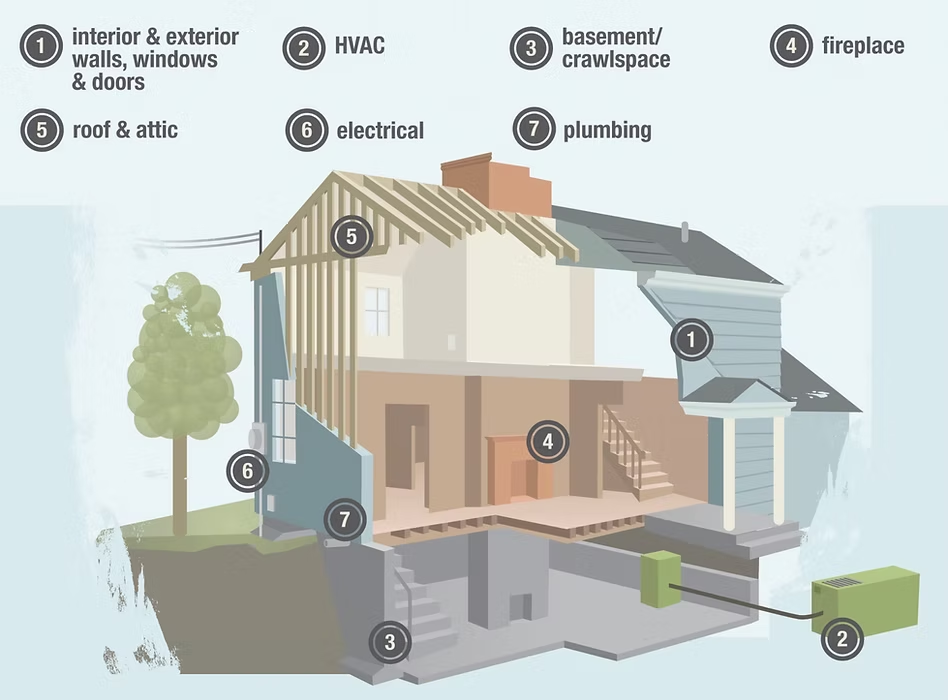
Your home is likely the largest purchase you'll ever make. A QuadPro inspection gives you a clear picture of exactly what you're buying — every visible system evaluated, every concern documented, and every finding explained in plain language. Whether you're a first-time buyer or a seasoned homeowner, knowing the condition of these key systems before you close protects your investment and your family.
Watch this video on the inspection process and what to pay attention to when evaluating a property.
Call or send us a message — we'll get you booked fast.
From standard buyer inspections to specialized services, QuadPro covers everything your home needs evaluated.
Every inspection covers all major systems. Choose the type that fits your situation.
Our flagship service — a thorough top-to-bottom evaluation of all accessible systems and components. Know exactly what you're buying before you close.
| Up to 1,500 sq ft | $325 |
| 1,501 – 2,000 sq ft | $375 |
| 2,001 – 2,500 sq ft | $425 |
| 2,501 – 3,000 sq ft | $475 |
| 3,001+ sq ft | Call for quote |
Sellers: get ahead of surprises. A pre-listing inspection lets you fix issues on your own timeline, price confidently, and avoid renegotiations at closing.
| Up to 1,500 sq ft | $280 |
| 1,501 – 2,000 sq ft | $320 |
| 2,001 – 2,500 sq ft | $365 |
| 2,501 – 3,000 sq ft | $405 |
| 3,001+ sq ft | Call for quote |
Still within your builder's 1-year warranty? Let us catch defects before your coverage expires. Protect your new-construction investment.
Many insurers — especially for older homes — require a 4-point inspection, a wind mitigation report, or both before issuing or renewing a policy. We provide both.
Covers the four systems insurers care most about: roof, electrical, plumbing, and HVAC. Required by most carriers for homes 20+ years old. Typically completed in 1–2 hours.
Documents your home's wind-resistant features — roof covering, roof-to-wall connections, and opening protections. Required by many carriers and can qualify you for significant premium discounts.
Every Buyer's Home Inspection covers all major systems and components — nothing skipped, nothing glossed over.
From booking to report delivery, here's exactly what to expect.
Call or email to book. We'll confirm a time that works for your closing timeline — often same week.
We conduct a thorough 2–3 hour evaluation. You're welcome and encouraged to attend and ask questions.
Receive a detailed, photo-rich digital report within 24 hours — readable on any device, easy to share.
Have questions after reviewing? Call us directly — we're available to walk you through every finding.
Call or send us a message. We'll answer everything before you book.
Tim Putala
Inspector Photo
Living in Southeast Georgia, I understand the challenges that come with homes in our region - from coastal humidity and moisture intrusion to pier-and-beam foundations and aging electrical panels. My goal is simple: give you the information you need to make a confident decision.
Buying or selling a home is one of the biggest financial decisions you will ever make. Every inspection I perform gets my full attention and my honest assessment. I take pride in clear communication and detailed reporting, to help support my clients in their decision-making.
I'm not just here for the inspection — I'm available before, during, and after to answer your questions. You can call me directly. That's how I work.
📞 Call Us — (229) 300-3543


QuadPro covers six counties across Southeast Georgia. Not sure if your area is included? Give us a call.
Every QuadPro report is clear, photo-documented, and organized by system — so you can act on findings immediately.
Every finding is clearly rated so you know exactly what needs attention and what can wait: ⚠ Safety Concern · ● Major Defect · ● Minor Defect · ✓ Maintenance · ✓ Satisfactory
All inspection photos are embedded directly in the report next to the finding they document. No guessing which picture goes with which problem.
No inspection jargon. Every finding is explained clearly so buyers, sellers, and real estate agents can all understand and act on the information.
Descriptions include enough specifics — location, scope, material type — that contractors can quote repairs directly from the report without a separate site visit.
Reports are delivered as a secure digital link — open on your phone, tablet, or laptop. Share with your agent or contractor in seconds.
Have questions after reading? Call us directly. We'll walk through every finding, explain the context, and help you understand what matters most.
See exactly what your clients receive.
You'll receive a report just like this — within 24 hours of your inspection.
Everything you need to know about home inspections — answered plainly.
Call us directly — we're happy to answer before you even book.
Helpful articles for homebuyers, sellers, and real estate professionals in Southeast Georgia.
Regional factors like humidity, crawl space conditions, and older electrical systems make local inspection knowledge essential.
High humidity, poor ventilation, and missing vapor barriers create conditions that lead to wood rot and mold. Here's what to look for.
Georgia's warm, humid climate makes it one of the highest-risk termite states in the country. Learn what lenders require and why it matters.
Many homes in Southeast Georgia still have Federal Pacific or Zinsco panels. Here's why they're a concern and what options buyers have.
A pre-listing inspection can prevent surprises, speed up closing, and give sellers leverage in negotiations. Here's when it makes sense.
Understanding severity ratings, what to ask the seller to fix, and how to prioritize repairs after your inspection report arrives.
Regional climate and housing stock create inspection priorities you won't find in a national checklist.
Buying a home in Southeast Georgia is different from buying in Atlanta or Charlotte. Our climate is humid, our housing stock is older, and regional conditions create inspection findings that national checklists simply don't prepare buyers for. Here are five things every local homebuyer should know before closing.
Most homes in the Waycross area and surrounding counties sit on pier-and-beam foundations with crawl spaces — not slabs. That matters because South Georgia's high humidity (regularly above 70%) creates the perfect environment for moisture intrusion, wood rot, and mold growth underneath homes. A missing or deteriorated vapor barrier, inadequate ventilation, or standing water in the crawl space can indicate serious structural and air quality problems.
During your inspection, your inspector should physically enter the crawl space, not just peer in from the access hatch. Ask specifically what they found and whether a vapor barrier is in place and in good condition.
Georgia consistently ranks among the highest-risk states for subterranean termites. A general home inspection does not include a Wood Destroying Organism (WDO) report — that requires a licensed pest control professional. If you're using FHA or VA financing, your lender will require a clear WDO report before closing. Even if you're paying cash, skipping this inspection in South Georgia is a significant risk.
A WDO inspection typically costs $75–$150 and is one of the best investments a buyer can make in this region. Don't skip it.
A large portion of the housing stock in Southeast Georgia was built in the 1960s through 1980s, when Federal Pacific and Zinsco electrical panels were widely installed. Both brands have documented failure rates — breakers that don't trip when they should, creating fire risks. During an inspection, the electrical panel is always one of the first things we examine. If you're buying a home built before 1990, budget for the possibility that the panel may need to be replaced.
Air conditioning runs six or more months a year in South Georgia. That means an HVAC system here ages faster than the same unit would in a northern climate. During an inspection, we check the age of the equipment, the condition of coils and filters, duct connections, and whether the system is cooling properly. A unit over 12–15 years old may be functional but is approaching the end of its useful life — factor that into your offer or budget.
Southeast Georgia sees its share of severe thunderstorms, high winds, and occasional tropical weather. Roofs take a beating. During an inspection, we look for missing or damaged shingles, improper flashing at penetrations and valleys, signs of prior leaks at the attic deck, and the approximate age of the roof covering. An older roof that has survived multiple storm seasons without proper maintenance may have granule loss, lifted shingles, or compromised flashing that isn't obvious from the ground.
None of these issues should scare you away from buying — most are manageable with the right information. That's what a home inspection is for. If you have questions about what to expect before your inspection, feel free to call me directly at (229) 300-3543.
Educational content informed by InterNACHI® (International Association of Certified Home Inspectors) member resources. Tim Putala is an InterNACHI Certified Professional Inspector® (Member #NACHI26032930).
High humidity, poor ventilation, and missing vapor barriers create conditions that lead to wood rot and mold.
If I had to name one finding that shows up more often than any other in South Georgia home inspections, it's crawl space moisture. It's not dramatic — no burst pipes, no visible flooding — but it quietly causes more structural and air quality damage than most homeowners realize. Here's what's behind it and what to look for.
Southeast Georgia's climate is characterized by hot, humid summers and mild winters with consistently high relative humidity year-round. When warm, moist outside air enters a crawl space — through vents, gaps, or an open access door — it meets the cooler surfaces of the floor joists and subfloor above. The air cools and its moisture condenses onto the wood. Over months and years, this repeated wetting and drying cycle degrades wood, promotes mold growth, and can attract wood-destroying insects.
A vapor barrier is a sheet of polyethylene plastic laid across the soil of a crawl space to limit ground moisture from evaporating upward. Without it — or with one that's torn, incomplete, or not properly lapped at seams — the crawl space essentially has a moisture source baked into it regardless of ventilation. In South Georgia, this is one of the most common deficiencies we find in homes built before the 1990s.
A properly installed vapor barrier (6-mil poly, fully covering the soil and lapped 12 inches at seams) can dramatically reduce crawl space humidity and is one of the most cost-effective improvements a homeowner can make.
Wood rot is caused by fungi that break down the structural fibers of wood in the presence of moisture. In a crawl space, we look for:
Localized rot can often be sistered (a new joist added alongside the damaged one). Widespread damage may require more extensive remediation and should be evaluated by a structural contractor.
Not all mold in a crawl space is actively growing. Older mold that has dried out appears white or gray and chalky. Active mold is typically darker and may have a fuzzy texture. The distinction matters because active mold indicates an ongoing moisture source that needs to be addressed — not just cleaned. If moisture conditions aren't corrected first, mold will return.
It's worth noting that a home inspector identifies visible evidence of mold-like growth and recommends further evaluation by a qualified professional. We don't test or remediate — we flag it so you know what you're dealing with before you buy.
Building codes have historically required 1 square foot of net free vent area per 150 square feet of crawl space area (or 1:300 with a vapor barrier). In practice, many older homes in our area fall short of this ratio, and blocked, painted-over, or damaged vents reduce actual airflow further. We check vent count, spacing, and condition during every crawl space inspection.
If your inspection report notes crawl space moisture, don't panic — but don't ignore it either. Get a clear answer on whether a vapor barrier is present, whether active mold is visible, and whether any wood shows signs of decay. Armed with that information, you can get remediation estimates and negotiate accordingly, or request that the seller address conditions prior to closing.
Questions? Call me directly at (229) 300-3543.
Educational content informed by InterNACHI® (International Association of Certified Home Inspectors) member resources. Tim Putala is an InterNACHI Certified Professional Inspector® (Member #NACHI26032930).
Georgia's warm, humid climate makes it one of the highest-risk termite states in the country.
Georgia is part of what the USDA calls the "moderate to heavy" termite infestation zone — which covers the entire Southeast and is one of the highest-risk regions in the United States. For homebuyers and sellers in the Waycross area, understanding how WDO (Wood Destroying Organism) inspections work and what lenders require is essential.
A standard home inspection and a WDO inspection are two separate services performed by two different professionals. As a home inspector, I evaluate the visible and accessible components of a home — structure, roof, electrical, plumbing, HVAC, and more. A WDO inspection is performed by a licensed pest control professional and focuses specifically on evidence of wood-destroying organisms including termites, wood-boring beetles, and wood-decaying fungi.
You need both. A home inspector may note evidence of prior termite damage, but a formal WDO report from a licensed pest control operator is a separate document with legal standing for disclosure and lending purposes.
If you're purchasing with FHA or VA financing, a clear WDO report (sometimes called a CL-100 or termite letter) is required before closing. The report must show no active infestation and may require treatment and clearance if evidence of activity is found. Conventional lenders vary — some require it, some don't — but in a high-risk state like Georgia, it's wise to get one regardless of loan type.
A licensed pest control inspector will examine the accessible areas of the home for evidence of:
The WDO report will distinguish between active infestation and evidence of prior (inactive) damage. Prior damage alone doesn't necessarily require treatment, but it does need to be disclosed. Active infestation always requires treatment before closing if financing is involved, and most cash buyers wisely require the same.
It's important to understand that prior termite damage to structural wood components (floor joists, sill plates, rim joists) may not be fully visible during a WDO inspection if it's behind finished walls or under insulation. A home inspector's probing during the crawl space inspection can surface additional evidence.
If your home has had prior termite treatment, locate the treatment records and transferable warranty (if any) before listing. Many pest control companies offer annual renewable warranties that transfer to the new owner — this is a meaningful selling point and provides buyers with confidence. Disclose all known prior activity and treatment in writing.
Liquid soil treatment (termiticide barrier) for a typical Southeast Georgia home generally runs $800–$1,500 depending on linear footage and construction type. Bait station systems are an alternative at similar or higher cost with ongoing monitoring. If active infestation has caused structural damage, repair costs are separate and can vary significantly.
Have questions about what we found during an inspection or what to do next? Call me at (229) 300-3543.
Educational content informed by InterNACHI® (International Association of Certified Home Inspectors) member resources. Tim Putala is an InterNACHI Certified Professional Inspector® (Member #NACHI26032930).
Many homes in Southeast Georgia still have Federal Pacific or Zinsco panels. Here's why they're a concern.
The electrical panel is one of the most important components we evaluate during every inspection. In Southeast Georgia, where a large share of the housing stock dates to the 1960s through 1980s, older panel brands and outdated wiring configurations show up regularly. Here's what we look for and why it matters.
FPE Stab-Lok panels were installed in millions of American homes from the 1950s through the 1980s. The concern: independent testing has shown that Stab-Lok breakers have a significantly elevated failure rate — meaning they may not trip when they're supposed to during an overload or short circuit. A breaker that doesn't trip allows current to continue flowing, which can generate heat and start a fire in the walls before anyone notices.
These panels are not automatically condemned by the inspection, but they are flagged as a safety concern and typically recommend evaluation by a licensed electrician with possible replacement. Home insurance companies increasingly refuse to cover homes with FPE panels, which can complicate financing and resale.
Zinsco panels, sold under the Zinsco and GTE-Sylvania names, have similar documented issues. The bus bar design allows breakers to weld themselves to the bus in some failure modes, making them impossible to turn off manually. This brand is less common than FPE in our area but still appears in homes from the same era. Same recommendation applies: evaluation by a licensed electrician and likely replacement.
A double-tap occurs when two wires are connected to a single breaker terminal that is rated for only one conductor. This is one of the most common electrical deficiencies we find in older homes — often the result of circuits being added over time without proper planning. Double-taps can cause overheating at the terminal, arcing, and tripped breakers under normal loads. The fix is usually straightforward: add a tandem breaker or a subpanel, depending on available space.
Some breakers (like certain Square D and Siemens models) are specifically listed for two conductors. A home inspector can't always confirm listing at the terminal — an electrician should evaluate and confirm.
During the 1960s and 1970s, aluminum was used for branch circuit wiring (the wiring that goes from the panel to outlets and switches) as a cost-saving alternative to copper. Aluminum expands and contracts more than copper, which can loosen connections over time, leading to arcing and fire risk at outlets, switches, and splices. Homes with aluminum branch circuit wiring (not to be confused with aluminum service entrance conductors, which are normal and safe) require special outlets and devices rated for aluminum, or pigtailing with copper using approved connectors. This is a real safety issue that requires an electrician's evaluation.
Ground Fault Circuit Interrupter (GFCI) protection is required at locations near water: kitchens, bathrooms, garages, exterior outlets, and crawl space receptacles. We test every GFCI outlet and GFCI breaker for proper operation during every inspection. Missing GFCI protection in these areas is a common finding in older homes and is a simple, low-cost fix.
Arc Fault Circuit Interrupter (AFCI) breakers detect dangerous arcing conditions and are required in modern construction for bedroom circuits and, in newer code cycles, nearly all living areas. Older homes won't have them, and while retrofitting isn't always required, AFCI breakers are a meaningful safety upgrade worth considering.
If your inspection report identifies an FPE or Zinsco panel, double-tapped breakers, or aluminum branch wiring, don't panic — but do take it seriously. Get a quote from a licensed electrician before closing. Panel replacement typically runs $1,500–$3,000 depending on amperage and complexity. Use that information to negotiate with the seller or budget for the work post-closing.
Questions about electrical findings in your inspection report? Call me at (229) 300-3543.
Educational content informed by InterNACHI® (International Association of Certified Home Inspectors) member resources. Tim Putala is an InterNACHI Certified Professional Inspector® (Member #NACHI26032930).
A pre-listing inspection can prevent surprises, speed up closing, and give sellers leverage in negotiations.
Most homeowners think of inspections as something buyers do — but a growing number of sellers are getting inspections done before they list. A pre-listing inspection (also called a seller's inspection) gives you the same information a buyer's inspector would find, but on your own timeline and without the pressure of a contract on the line.
The most powerful benefit of a pre-listing inspection is simple: you find out what's in your home before a buyer does. That matters because discoveries during a buyer's inspection happen at the worst possible moment — when you're under contract, on a deadline, and at maximum negotiating disadvantage. When you know about a problem in advance, you can choose to fix it, price around it, or disclose it proactively. All three options are better than being blindsided.
Listing agents will tell you that accurate pricing is the single biggest factor in how quickly and profitably a home sells. A pre-listing inspection gives you a clearer picture of your home's actual condition, which helps you and your agent price it accurately from day one. Overpriced homes that fall back under contract inspection pressure are a common pattern — a pre-listing inspection helps avoid that cycle.
Georgia law requires sellers to disclose known material defects to buyers. Once you have an inspection report, the findings become known to you — which means they need to be disclosed. Some sellers worry this creates liability, but the alternative (a buyer discovering undisclosed defects after closing) carries far greater legal and financial risk. Proactive disclosure, especially with documentation showing the issue was identified and addressed, builds buyer confidence and closes deals.
A pre-listing inspection report shared with prospective buyers signals that you're a transparent seller — which reduces buyer anxiety and often results in cleaner offers.
When a buyer's inspection finds a problem, you're typically given 7–10 days to respond. That's not enough time to get multiple contractor quotes, schedule repairs, and verify the work is done properly. A pre-listing inspection gives you weeks or months to address issues at your own pace, using contractors you trust, at prices you've shopped. You're in control.
One of the leading causes of delayed or failed closings is the negotiation period after a buyer's inspection. When sellers have already addressed the major findings — or disclosed them with documentation — there's less to negotiate, less uncertainty, and fewer reasons for deals to fall through. Buyers and their agents respond well to a seller who has done their homework.
A pre-listing inspection makes the most sense for sellers who want to maximize their sale price, minimize closing delays, and enter the transaction with full information. It may be less valuable for sellers doing a straight as-is sale who intend to disclose nothing and price accordingly — though even then, knowing what the buyer will find allows you to price more precisely.
Pre-listing inspections are priced slightly lower than buyer's inspections. See our pricing page for details, or call (229) 300-3543 to schedule.
Educational content informed by InterNACHI® (International Association of Certified Home Inspectors) member resources. Tim Putala is an InterNACHI Certified Professional Inspector® (Member #NACHI26032930).
Understanding severity ratings, what to negotiate, and how to prioritize repairs after your report arrives.
Your inspection report has arrived and it's 40 pages long. Before you panic, understand this: a thorough inspection report is a good thing. A long report means your inspector was paying attention. Most findings in a typical home inspection are maintenance items, not deal-breakers. Here's how to read it and what to do next.
Every inspection report uses some form of rating system to communicate the seriousness of findings. At QuadPro, we use three ratings:
Focus your energy first on anything rated Critical, then review Concern items to understand their scope and urgency.
Regardless of cost, safety-related findings should always be addressed. These include things like exposed wiring, non-functional smoke or carbon monoxide detectors, active gas leaks, missing handrails on stairs, inoperable emergency egress windows in bedrooms, and other conditions that pose an immediate risk to occupants. In a negotiation, safety items are the strongest basis for repair requests because they're non-optional — they need to be fixed by someone.
Inspection findings generally fall into two categories: issues with major systems (roof, foundation, electrical, plumbing, HVAC, structure) and routine maintenance items (caulk, weatherstripping, minor wood trim, dirty gutters). The two categories carry very different weight in a negotiation.
A cracked heat exchanger in the HVAC system is a major safety and mechanical finding worth thousands of dollars. Missing caulk around a tub surround is a $20 fix. Both may appear in your report — don't treat them the same.
When reviewing your report, mentally sort findings into "major system issues," "safety concerns," and "maintenance items." Your negotiation focus should be on the first two categories.
In a typical real estate transaction, buyers submit a repair request (also called a Due Diligence Request or Repair Addendum) based on the inspection findings. There are three approaches:
Your real estate agent is your best resource for strategy here. They know the seller's situation, the market conditions, and what requests are reasonable in the current environment.
A 40-page inspection report on a 1970s home in South Georgia is normal. Most of it will be documentation, photos, and maintenance recommendations — not crises. If you received a detailed report, you received a good inspection. The goal is information, and now you have it.
If any finding in your report is unclear, call me. I'm happy to walk through the report with you, explain what I found, put findings in context, and help you understand what's urgent versus what can wait. That conversation is part of the service.
Reach me directly at (229) 300-3543 or tim@quadproinspections.com.
Educational content informed by InterNACHI® (International Association of Certified Home Inspectors) member resources. Tim Putala is an InterNACHI Certified Professional Inspector® (Member #NACHI26032930).
Fast turnarounds, clear reports, and a direct line to your inspector — everything your clients and transactions need.
Inspection delays cost deals. We deliver detailed reports within 24 hours, answer your clients' questions directly, and never leave anyone guessing.
Reports delivered the same evening in most cases — never later than 24 hours, guaranteed. No waiting around during a tight closing window.
You and your clients can call us directly with questions. No answering service, no runaround — real answers from the inspector who did the job.
Digital reports with photos and severity ratings go to your client — and to you. Provide your email when you refer and you'll be CC'd on every report automatically.
Same-week appointments typically available. We work around your closing timeline — not the other way around.
Southeast Georgia native with deep understanding of regional construction, common defects, and issues specific to our climate and housing stock.
We treat every client with respect and explain findings in plain language — no alarming buyers unnecessarily or dismissing real concerns.
Getting your clients inspected is simple. Here's all it takes.
Reach us at (229) 300-3543 with the property address and your client's contact info. We'll take it from there.
We confirm scheduling directly with your buyer or seller — you stay in the loop without being the go-between.
Your client receives a complete digital report within 24 hours — guaranteed. Give us your email when you call and you'll be CC'd automatically. Everyone works from the same information.
Skip the phone tag. Send your clients directly to our booking page — they pick a time, we confirm, and you get CC'd on the report.
Call or email us directly — we'll take it from there.
Call us or fill out the form and we'll get back to you within a few hours.
Tell us about the property and we'll get back to you with availability and pricing.
Prefer to book online? Use our scheduling calendar to pick a date and time that works for you. You'll receive a confirmation email immediately.
Choose from available slots that fit your closing timeline.
Provide the address, square footage, and any special notes.
You'll receive a confirmation email with all the details.
Prefer to call? Reach us at (229) 300-3543
Pick a date and time that works for you. We'll send a confirmation immediately — no waiting.
We've made booking as simple as possible. Choose your preferred date and time from our live calendar, provide a few property details, and you're confirmed.
Choose from available slots that fit your closing timeline.
Provide the address, square footage, and any access notes.
You'll receive a confirmation email right away. Your inspection is locked in.
Have questions first?
Call us at (229) 300-3543 or email tim@quadproinspections.com. We're happy to answer before you schedule.
Click below to view available dates and times and book your inspection instantly.
Open Scheduling CalendarYou'll receive a confirmation email right away.
After you book, we'll send you a Georgia Home Inspection Agreement via email. This must be signed before your inspection takes place.
Your agreement is processed through InterNACHI's secure, legally binding e-signature system. InterNACHI records the exact date, time, and IP address of your signature and stores the agreement indefinitely — providing real legal protection for both parties.
Sign My Agreement →Enter the email address used when booking to locate your agreement.
Legally Binding
E-signature is valid and enforceable under Georgia law.
Court-Ready Records
InterNACHI stores your agreement and can testify to the exact time and date it was signed.
Georgia-Specific
Our agreement follows Georgia state law and InterNACHI's Standards of Practice.
A little preparation helps us serve you better. Here's what to have in order before inspection day.
Ensure the home is accessible on inspection day. Keys, lockbox codes, or agent access should be confirmed in advance.
Approximate square footage, age of the home, and any known conditions help us plan and price the inspection accurately.
Water, electricity, and gas should be active so we can fully test all systems and appliances during the inspection.
We follow the InterNACHI Standards of Practice on every inspection. Understanding what a home inspection is — and what it isn't — helps you get the most out of the process.
We perform a thorough visual examination of all accessible areas of the property. We don't open walls, move belongings, or dismantle systems — we inspect what can be seen and accessed safely.
Our findings reflect conditions observed on the day of the inspection. An inspection is not a prediction of future performance or a guarantee that no additional issues will emerge later.
We report on material defects — issues that may significantly affect the value of the property or pose an unreasonable risk to people. Minor cosmetic concerns or normal wear are noted but are not the focus.
Every inspection results in a detailed written report identifying any material defects found in the systems and components we examine. Reports are delivered digitally within 24 hours.
Per the InterNACHI Standards of Practice, home inspections have defined limitations. These aren't shortcomings — they reflect the scope of a proper visual inspection and keep the process objective.
We don't determine whether the property complies with local building codes or regulations. A home inspection and a code inspection are two different things.
We don't assess market value, marketability, or insurability. We evaluate physical condition — not financial value or purchase advisability.
We cannot identify defects that are hidden behind walls, under flooring, beneath insulation, or in areas that are not accessible or visible during the inspection.
Testing for radon, mold, asbestos, lead paint, air quality, or other environmental hazards is outside the scope of a standard home inspection. These require separate specialized testing.
We don't move furniture, appliances, stored items, rugs, or other personal property. If an area is obstructed, it may not be inspectable on the day of the visit.
We don't operate systems that have been shut down, don't function with normal controls, or that pose a safety risk to operate. Utilities must be active for a complete inspection.
Have questions about scope?
If you have specific concerns about the property — a crawl space, older systems, or something unusual — call us before booking at (229) 300-3543. We'll make sure your inspection covers what matters most.
Our inspections are guided by the highest standards in the industry — the InterNACHI Code of Ethics and Standards of Practice.
As an InterNACHI Certified Professional Inspector, we hold ourselves to a strict code of conduct on every inspection — so you always know exactly what you're getting.
We inspect every property with a clear, unbiased perspective. Our findings are never influenced by outside interests — we work for the client, and only the client.
We report all material defects and conditions discovered during the inspection. Nothing is minimized to make a sale easier or a report look cleaner.
We never accept referral fees from contractors, repair services, or any party with a financial interest in the inspection outcome.
InterNACHI requires members to complete ongoing education each year. We stay current on building science, codes, and inspection methods — so our clients benefit from up-to-date knowledge.
Inspection findings belong to our client. We keep all property and client information strictly confidential and never share reports without authorization.
We represent our credentials, qualifications, and services accurately. What you see on this site is exactly what you get when we show up at the property.
Our inspections follow the InterNACHI Standards of Practice — a nationally recognized framework that defines what inspectors must examine and report on at every inspection.
Foundation, framing, floor structure, wall and ceiling structure, and roof structure.
Roof covering materials, flashings, gutters, downspouts, and drainage.
Service entrance, panels, branch circuits, outlets, fixtures, and grounding.
Water supply, drain, waste, and vent systems, water heater, fixtures, and faucets.
Heating and cooling equipment, distribution systems, filters, and controls.
Siding, trim, windows, doors, garage, grading, driveways, and walkways.
Walls, ceilings, floors, doors, windows, stairways, and railings.
Built-in appliances, counters, cabinets, fixtures, ventilation, and fans.
Before every inspection, we use the InterNACHI Client Agreement — a clear, plain-language document that explains exactly what is included, how disputes are handled, and your rights as a client.
View the Client Agreement →Tim Putala is a verified InterNACHI Certified Professional Inspector. You can confirm his membership and credentials directly on the InterNACHI website.
Free guides and checklists to help you buy, maintain, and protect your home — from our team to yours.
Enter your name and email to unlock our full library of homeowner guides — no spam, just useful resources.
We respect your privacy. Your info is never sold or shared.
Click any guide below to download it. All resources are free.
How long do roofs, HVAC systems, appliances, and other home components typically last? Use this chart to plan repairs and budgets.
Download PDFWhat sellers and buyers should do before inspection day to ensure a smooth, thorough process.
Download PDFA full year of maintenance tasks organized by season — keep your home in top shape year-round.
Download PDF